Corn Yield Calculator
Enter your row width, ear count, kernel rows and kernels per row to estimate corn yield in bushels per acre and tonnes per hectare.
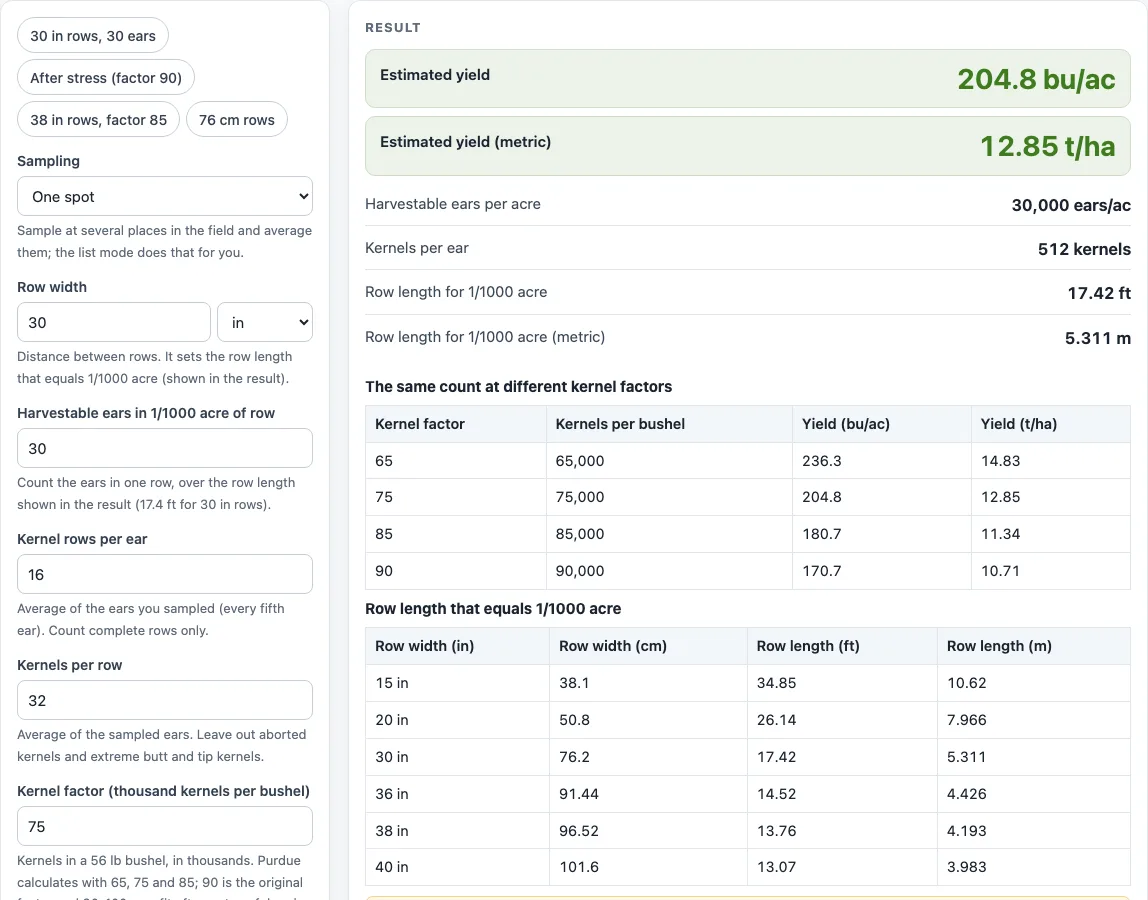
How to use the corn yield calculator
- Enter your row width in the Row width field, in inches or centimetres. The page shows the row length that equals 1/1000 acre.
- Set Sampling to One spot or Several spots (list).
- In One spot mode, enter Harvestable ears in 1/1000 acre of row, Kernel rows per ear and Kernels per row. Use the averages from your sampled ears.
- In Several spots (list) mode, type one line per spot in Sampling spots (one per line). Each line holds three numbers: ears, rows and kernels per row, separated by spaces, commas or tabs. You can enter up to 200 lines.
- Check Kernel factor (thousand kernels per bushel). It starts at 75.
- Read Estimated yield (bu/ac) and Estimated yield (metric) (t/ha). In list mode, also check Lowest spot and Highest spot.
- If you are unsure which kernel factor fits your crop, compare the table, which shows your count at factors 65, 75, 85 and 90.
Four preset buttons fill in example values: “30 in rows, 30 ears”, “After stress (factor 90)”, “38 in rows, factor 85” and “76 cm rows”. Use Copy link to share your inputs, since the link keeps all of them. Copy result copies the output, and Print / save as PDF prints your inputs, results, steps and the date. How it was calculated shows each step with your numbers. Reset clears the form.
How do I estimate corn yield before harvest?
The yield component method estimates yield from three counts taken in the field: harvestable ears, kernel rows per ear, and kernels per row. Multiply the rows by the kernels per row to get kernels per ear, then multiply by the number of ears and convert kernels to bushels with the kernel factor. Purdue Extension, whose method this tool follows, takes these counts in several places across the field and averages them.
Sampling follows a few rules. Purdue samples every fifth ear and leaves out aborted kernels and extreme butt and tip kernels, since those do not fill like the rest of the ear. Count the ears in a row length that equals 1/1000 acre, so the ear count can be scaled to a whole acre. Repeat the count in several places, because one spot can be unrepresentative of the field. Averaging the spots gives a more reliable estimate than any single count. Even so, treat the answer as a planning figure: Purdue notes that yield is overestimated after poor grain fill and underestimated after excellent grain fill, so the same counts can mean a different yield in a different season.
How do I calculate bushels per acre from ears, rows and kernels per row?
The formula is yield (bu/ac) = ears × (rows × kernels per row) ÷ kernel factor. The kernel factor is the number of thousand kernels that make up one bushel. First multiply rows by kernels per row to get kernels per ear. Then multiply that by the ears per acre and divide by the kernel factor.
Ears per acre come from the row length. Divide 43,560 ft² by 1000 to get the area of 1/1000 acre, then divide by the row width in feet to get the row length. The tool multiplies the ears counted in that length by 1000 to give harvestable ears per acre.
Worked example: 30 in rows, 30 ears, 16 kernel rows and 32 kernels per row. That gives 16 × 32 = 512 kernels per ear. Then 30 × 512 ÷ 75 = 204.8 bu/ac. The same count at a kernel factor of 90 gives 170.7 bu/ac, so the factor you choose changes the result a lot.
Sources
- Purdue Extension, R. Nielsen, Estimating Corn Grain Yield Prior to Harvest — yield component method, 1/1000 acre row length, kernel factors 65, 75, 85 and 90, accuracy of about plus or minus 20 bu/ac
- USDA ERS Agricultural Handbook 697 — corn weighs 56 lb per bushel
- Penn State Extension, Understanding grain discount schedules — market moisture for corn is 15.5 %
Worked examples
| Input | Result |
|---|---|
| 30 in rows, 30 ears, 16 rows × 32 kernels, kernel factor 75 | 204.8 bu/ac (12.9 t/ha) |
| 38 in rows, 26 ears, 18 rows × 36 kernels, kernel factor 85 | 198.2 bu/ac (12.4 t/ha) |
| 76 cm rows, 3 spots, kernel factor 75 | 212.8 bu/ac (13.4 t/ha) |
Calculated by the tool above with these values.
Frequently asked questions
How accurate is the yield component method?
Purdue puts the method at about plus or minus 20 bu/ac. It tends to overestimate yield after poor grain fill and underestimate it after excellent grain fill.
Why do I need to sample several places in the field?
A single spot may not match the rest of the field. Purdue advises repeating the counts across the field and averaging them. In Several spots (list) mode, the tool averages the yields of each line and shows the lowest and highest spot so you can see the spread.
What kernel factor should I use?
The default is 75. Purdue calculates with 65, 75 and 85. The original factor is 90, meaning 90,000 kernels per 56 lb bushel, and a value of 90 to 100 may fit after a stressful grain fill. Recent trials averaged about 76,000 kernels per bushel.
How do I convert corn bushels per acre to tonnes per hectare?
Multiply bushels per acre by 0.06277. One bushel of corn is 56 lb, and 1 bu/ac equals 56 × 0.45359237 kg ÷ 1000 ÷ 0.40468564 ha per acre, which is 0.06277 t/ha. The tool does this conversion for you in the metric output.
How many ears should I count for 30 inch rows?
For 30 in rows, measure 17.424 ft (5.31 m) of row, which equals 1/1000 acre. Count the harvestable ears in that length and enter the number in the ears field. For 15 in rows the length is 34.85 ft, and for 36 in rows it is 14.52 ft.
Is the calculator free, and is anything I type uploaded?
Yes, it is free and needs no sign-up. It runs in your browser, and nothing you type is uploaded.
Related tools
- Grain shrink calculator: use it to estimate how much weight grain loses when it is dried to a different moisture.
- Seeding rate calculator: use it to work out how many seeds to plant per acre for a target population.
- Grain bin capacity calculator: use it to check how much grain a bin will hold before harvest.
- Acreage calculator: use it to convert field dimensions into acres.
- Fertilizer calculator: use it to work out how much fertilizer a field needs for a given rate.
- Corn nitrogen rate calculator: use it to estimate a nitrogen rate for a corn crop.