Egg Incubation Calculator
Pick the bird and the day the eggs went into the incubator to get the hatch date, the day to stop turning and the temperature settings.
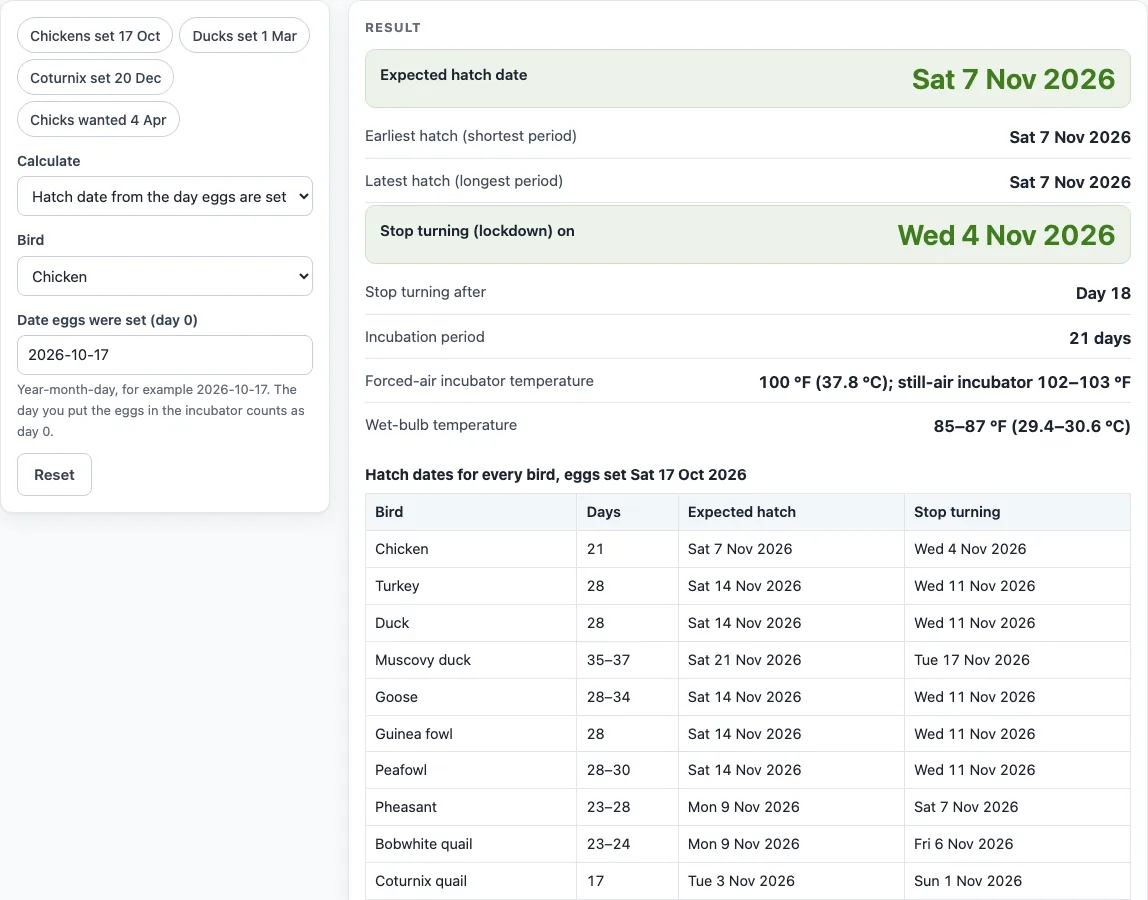
How to use the Egg Incubation Calculator
- In Calculate, choose “Hatch date from the day eggs are set” or “Day to set eggs for a wanted hatch date”.
- In Bird, choose the species, for example Chicken, Duck, Muscovy duck, Goose or Coturnix quail.
- For the first mode, type Date eggs were set (day 0) as year-month-day, for example 2026-10-17. The day you put the eggs in counts as day 0.
- For the second mode, type the Wanted hatch date the same way.
- Read Expected hatch date. For birds whose period is a range, such as Muscovy duck (35-37 days) or goose (28-34 days), also read the earliest and latest dates.
- Read Stop turning (lockdown) on. This is the last day the eggs are turned; after it they stay still until the hatch.
- Check Forced-air incubator temperature and Wet-bulb temperature against your incubator. A still-air incubator needs 2-3 °F more.
- Open the table below the results to see the hatch date and lockdown day for all 13 birds from the same set date.
The example buttons load samples. Reset restores the defaults, Copy link stores your inputs in the page address, Copy result copies the result lines, and Print / save as PDF prints the inputs and steps with the date.
How long does it take for chicken eggs to hatch?
Chicken eggs take 21 days. Count the day the eggs are set as day 0, so eggs set on Saturday 17 October 2026 hatch on Saturday 7 November 2026. The tool adds the incubation period to the set date; it does not count the set day as day 1. Eggs set at different times of day still use the same calendar-day count, so the exact hour of hatching depends on when in the day you set them.
Hatch dates for ducks, geese, quail and other birds
The incubation periods come from Mississippi State University Extension: chicken 21 days, turkey 28, duck 28, Muscovy duck 35-37, goose 28-34, guinea 28, peafowl 28-30, pheasant 23-28, bobwhite quail 23-24, Coturnix quail 17, chukar partridge 23-24, grouse 25 and pigeon 17. For birds with a range, the tool uses the first number as the expected day and the second as the end of the hatch window. For example, Muscovy eggs set on 10 February 2027 are due on 17 March 2027, with the window running to 19 March.
When do you stop turning eggs (lockdown)?
The source gives a last day of turning for each bird: day 18 for chicken, day 25 for turkey, duck, goose, guinea and peafowl, day 31 for Muscovy duck, day 21 for pheasant, day 20 for bobwhite and chukar, day 22 for grouse and day 15 for Coturnix quail and pigeon. The tool shows that day as a date. For chickens set on 17 October, it is Wednesday 4 November. Other extension guides use simpler rules, such as the last three days before hatching, so if you follow a different guide, use its day.
What temperature and humidity should the incubator use?
The same source lists a forced-air dry-bulb temperature of 99 or 100 °F, depending on the bird, with a wet-bulb temperature of 81 to 88 °F. For chickens that is 100 °F (37.8 °C) dry bulb and 85-87 °F wet bulb. It advises adding 2-3 °F for a still-air incubator. Many incubators are set by relative humidity instead of wet bulb, and manufacturers differ, so use your incubator’s manual.
Sources
- Mississippi State University Extension, Hatchery Management Guide for Game Bird and Small Poultry Flock Owners — incubation periods, last turning day, forced-air temperature and wet-bulb temperature for 13 birds (Tables 1 and 2, read 2026-10-17)
Worked examples
| Input | Result |
|---|---|
| Chicken, set 2026-10-17 | hatch Sat 7 Nov 2026, stop turning Wed 4 Nov 2026 |
| Duck, set 2027-03-01 | hatch Mon 29 Mar 2027, stop turning Fri 26 Mar 2027 |
| Coturnix quail, set 2026-12-20 | hatch Wed 6 Jan 2027, stop turning Mon 4 Jan 2027 |
| Chicken, hatch wanted 2027-04-04 | set on Sun 14 Mar 2027 |
| Muscovy duck, set 2027-02-10 | hatch Wed 17 Mar 2027, stop turning Sat 13 Mar 2027 |
Calculated by the tool above with these values.
Frequently asked questions
Is the calculator free, and is anything I type uploaded?
Yes, it is free. It runs in your browser, needs no sign-up, and nothing you type is uploaded.
Can I use the results in commercial work?
Yes. Results, steps and printouts can be used in any work, including a hatchery schedule or a class plan, and no attribution is needed. They are planning estimates, so check them against your incubator’s manual.
Do I count the day I set the eggs as day 1?
No. The tool counts the set day as day 0 and adds the incubation period, so chicken eggs set on the 1st hatch on the 22nd. If you count the set day as day 1, you will be one day off.
Can eggs hatch earlier or later than the date shown?
Yes. The date is an average. Temperature that is slightly low or high, egg storage time and the breed can move the hatch by a day or more. Birds with a range, such as geese and Muscovy ducks, have a wider window, shown as the earliest and latest dates.
Does the calculator tell me when to candle?
No. It gives the hatch date and the last turning day only. Candling days vary between guides, so follow the guide you use.
Can I use it to plan a hatch for a particular date?
Yes. Choose “Day to set eggs for a wanted hatch date”. For chicks wanted on 4 April 2027, it returns 14 March 2027 as the set date.
Related tools
- Cow gestation calculator: use it to plan calving dates for a breeding herd.
- Hay calculator: use it to work out how much hay a herd or flock of grazers needs.
- Pond volume calculator: use it to size a pond or a stock tank by volume.
- Seeding rate calculator: use it to set seed per acre for a crop.
- Irrigation calculator: use it to work out drip flow and run time.
- Grain bin capacity calculator: use it to find how much grain a bin holds.
- All calculators: use it to browse every calculator on the site.