Grain Bin Capacity Calculator
Enter the bin diameter and eave height, peak and hopper to get its bushel capacity and the grain weight.
The grain bin capacity calculator estimates how many bushels a round grain bin holds from its diameter, the grain depth at the sidewall, and the shape of the grain top. It also converts the bushel count into weight in tonnes and US tons for the grain you pick, and shows the volume in cubic feet and cubic meters.
It handles flat-floored bins and bins with a hopper bottom. Lengths can be entered in feet or meters, and the grain top can be level, peaked at a fill angle, or peaked to a height you enter.
The calculator is free, runs in your browser and needs no sign-up. Results are planning estimates, so check them against your own grain and bin information before relying on them.
How to use the Grain Bin Capacity Calculator
- Enter the Bin diameter and choose ft or m.
- Enter the Grain depth at the sidewall. For a full bin, use the sidewall (eave) height, measured from the floor, or from the top of the hopper in a hopper bin.
- Choose Top of the grain:
- Peaked at a fill angle: enter the Peak angle (degrees). The default is 25°; a study of 182 US bins measured a median of about 20° for corn and 22–26° for other grains.
- Peaked to a height I enter: enter the Peak height above the eave.
- Level (flat top): no peak inputs are needed.
- Choose the Grain. It sets the weight per bushel used for tonnes and tons.
- For a hopper, open More options, set Hopper bottom, and enter the hopper slope or height and the outlet diameter. Leave the outlet empty for a point.
- If you have a packing factor from a reliable source, enter it in Packing allowance (%). 0 means none.
- Read Bin capacity and the other result rows, and check any warnings.
The example buttons load sample bins, such as “30 ft bin, corn” or “9 m bin, wheat”. Reset restores the defaults, Copy link stores every input in the page address, and Copy result copies the result lines. Print / save as PDF prints the inputs, results and steps, and How it was calculated shows each step with your numbers.
How many bushels does a grain bin hold?
A bin holds the volume of its cylinder, plus the cone of grain above the sidewall if the top is peaked, plus a cone-shaped hopper at the base if it has one. That volume in cubic feet is then converted to bushels. One US bushel is 2,150.42 cubic inches, or 1.2445 cubic feet, so a bushel is a measure of volume, not weight.
A level top holds only the cylinder. A peaked top adds a cone, and a hopper bottom adds another cone at the base, so the same bin diameter and sidewall height can hold noticeably different amounts.
How do you calculate grain bin capacity?
Add the cylinder, the peak and the hopper, then divide by 1.2445. The cylinder is π × r² × depth, where r is half the diameter. The peak is ⅓ × π × r² × peak height. For a peak set by angle, the peak height is the radius times the tangent of the angle. Weight is bushels times the standard weight per bushel, such as 56 lb for corn or 60 lb for soybeans and wheat.
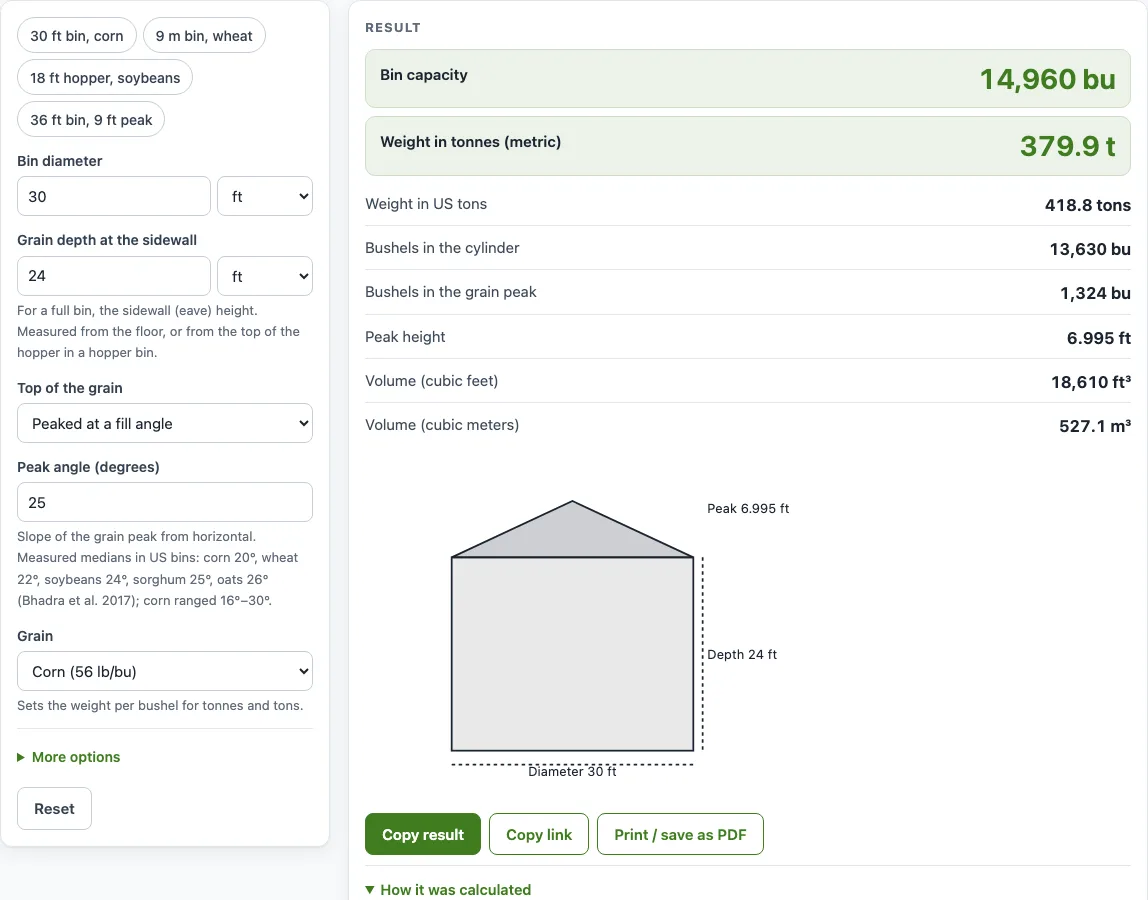
The default example works like this:
- Inputs: 30 ft diameter, 24 ft deep, 25° peak, corn.
- Peak height: 15 × tan 25° = 6.995 ft.
- Cylinder: π × 15² × 24 = 16,965 ft³.
- Peak: ⅓ × π × 15² × 6.995 = 1,648.1 ft³.
- Total: 18,613 ft³ (527.05 m³).
- Bushels: 18,613 ÷ 1.2445 = 14,956 bu.
- Weight: 14,956 × 56 lb = 379.9 tonnes (418.8 US tons).
Grain settles under its own weight, so a full bin can hold a few percent more than its loose volume suggests. The packing allowance adds the percentage you enter to the bushel count. It is 0 by default because the right figure depends on the grain, the depth and the moisture.
The angle of a grain peak also varies with the grain and how it is filled: in that field study, corn peaks ranged from about 16° to 30°. The tool flags angles below 10° or above 40°, a peak taller than 1.2 times the radius, and a bin more than three times taller than wide.
Sources
- NIST Handbook 44, Appendix C and NIST SP 811 — exact unit definitions (1 acre = 43,560 ft² = 4,046.8564224 m², 1 lb = 0.45359237 kg, 1 US gal = 231 in³); 1 US bushel = 2,150.42 in³ = 1.2445 ft³
- USDA ERS Agricultural Handbook 697 — standard bushel weights (corn 56, soybeans 60, wheat 60, barley 48, oats 32, sorghum 56, rye 56 lb)
- Bhadra et al. 2017, Field-Observed Angles of Repose for Stored Grain in the United States, Applied Engineering in Agriculture 33(1) — measured peak angles
Worked examples
| Input | Result |
|---|---|
| 30 ft diameter, 24 ft deep, 25° peak, corn | 14,956 bu (379.9 t) |
| 9 m diameter, 7 m deep, level fill, wheat | 12,637 bu (343.9 t) |
| 18 ft diameter, 12 ft deep, 25° peak, soybeans | 3,254.5 bu (88.57 t) |
| 36 ft diameter, 30 ft deep, 9 ft peak, corn | 27,801 bu (706.2 t) |
Calculated by the tool above with these values.
Frequently asked questions
Is the calculator free, and is anything I type uploaded?
Yes, it is free, needs no sign-up, and runs entirely in your browser. Nothing you type is uploaded.
Can I use the results in commercial work such as quotes and bids?
Yes. Results, steps and printouts may be used in any work, including quotes, bids and invoices, and no attribution is needed. The note under every result still applies: it is a planning estimate, so check the figures against your own grain and bin data.
What do the warnings mean?
A warning means a value looks unusual, so you can check it. The tool flags a peak angle below 10° or above 40°, a peak taller than 1.2 times the bin radius, a hopper slope below 20° or above 70°, a packing allowance above 15 %, and a bin more than three times taller than it is wide. Most often the cause is a wrong unit or a typo.
Can I switch between feet and meters?
Yes. Each length has its own ft or m menu, and the tool converts before it calculates. Results show bushels, tonnes, US tons, cubic feet and cubic meters together.
Which grains can I choose?
Corn, soybeans, wheat, barley, oats, sorghum, canola and rye. The choice only changes the weight, because bushels depend on volume alone.
Related tools
- Corn moisture shrink calculator: use it when corn moisture changes the amount of grain you are storing or selling.
- Square foot to acre converter: use it to convert an area from square feet into acres.
- Hectare to acre converter: use it when a field size is given in hectares and you need acres.
- Acreage calculator: use it to work out the acreage of a field from its dimensions.
- Acre per hour calculator: use it to estimate how many acres a machine covers in an hour.
- Fertilizer calculator: use it to work out product amounts for a field area once you have a rate from the label or an agronomist.
- Lawn fertilizer calculator: use it for lawn areas rather than field crops.
- All calculators: use it to browse every tool on the site.