Corn Moisture Shrink Calculator
Enter wet bushels or weight and the harvest and target moisture to get the shrink, dry bushels and water removed.
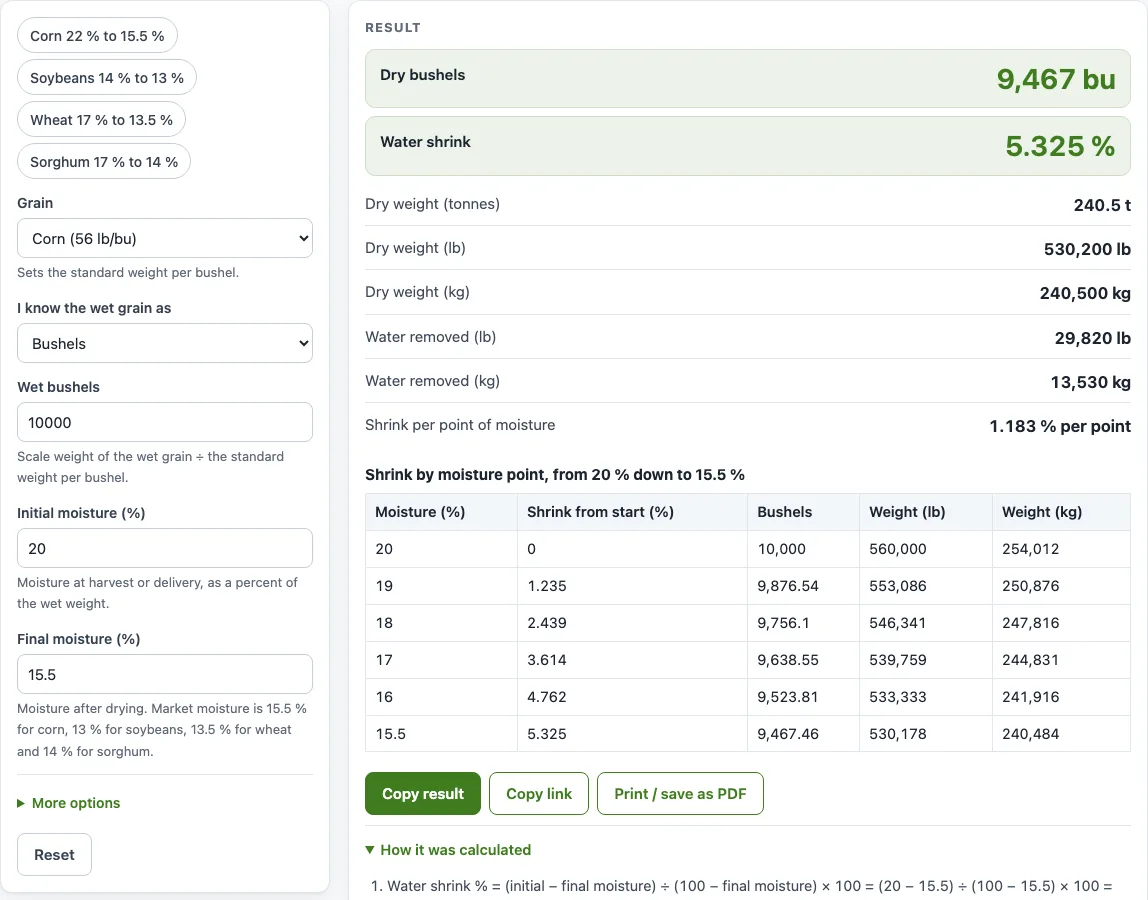
How to use the Grain Shrink Calculator
- Choose your crop in the Grain menu. It sets the standard weight per bushel, for example Corn (56 lb/bu) or Soybeans (60 lb/bu).
- Under I know the wet grain as, pick Bushels or Weight (lb, kg, tonnes or tons).
- Enter Wet bushels, or enter Wet weight and choose its unit (lb, kg, t or ton).
- Type the Initial moisture (%), the moisture at harvest or delivery.
- Type the Final moisture (%), the moisture after drying. The help text lists market moisture as 15.5 % for corn, 13 % for soybeans, 13.5 % for wheat and 14 % for sorghum.
- If you need them, open More options and enter Handling shrink (%) and the Elevator shrink factor (% per point). Leave the elevator field empty to skip the comparison.
- Read Dry bushels and Water shrink, along with the dry weight, the water removed and the table of shrink by moisture point. Check any warnings, such as an elevator factor below the water shrink, and open How it was calculated to see each step with your numbers.
The example buttons load ready-made cases, such as “Corn 22 % to 15.5 %” or “Soybeans 14 % to 13 %”. Reset restores the defaults, Copy link stores every input in the page address, Copy result copies the result lines, and Print / save as PDF prints a record with the date.
How do you calculate corn shrink?
Corn shrink is the percent of weight lost as water when wet corn is dried to market moisture. The formula is: water shrink % = (initial moisture − final moisture) ÷ (100 − final moisture) × 100.
For example, drying 10,000 bushels of corn from 20 % to 15.5 % gives (20 − 15.5) ÷ (100 − 15.5) × 100 = 5.325 % shrink. The dry bushels are 10,000 × (100 − 20) ÷ (100 − 15.5) = 9,467.46 bu, and the tool shows 29,822 lb (13,527 kg) of water removed.
Dry bushels follow the same logic. Multiply the wet bushels by (100 − initial) ÷ (100 − final). The result is smaller than the wet count because the water has left and the dry matter stays the same.
What is the shrink factor for corn?
The shrink factor is the percent of weight lost for each point of moisture removed. It equals 100 ÷ (100 − final moisture). At a final moisture of 15.5 %, that is 100 ÷ 84.5 = 1.183 % per point. Drying from 20 % to 15.5 % removes 4.5 points, so the shrink is about 4.5 × 1.183 = 5.33 %, which matches the full formula. The tool shows this value as Shrink per point of moisture.
Elevators often publish their own factor per point in a discount schedule. Enter it in Elevator shrink factor (% per point) and the tool multiplies it by the points removed. It then shows the elevator shrink, the bushels left after that shrink, and how many bushels the elevator takes beyond the water that actually left. For example, 5,000 bu of corn dried from 25 % to 15.5 % with a 1.4 % factor loses 13.3 % at the elevator, which is about 103 bu more than the 11.24 % water shrink.
How do you calculate soybean moisture shrink?
Soybean moisture shrink uses the same formula, with 13 % as the usual final moisture. For example, 3,000 bushels of soybeans dried from 14 % to 13 % gives (14 − 13) ÷ 87 × 100 = 1.149 % shrink, and 3,000 × 86 ÷ 87 = 2,965.5 dry bushels.
Sources
- Purdue Extension, National Corn Handbook NCH-61 — water shrink factor 100 ÷ (100 − final moisture), 1.183 % per point at 15.5 %
- USDA ERS Agricultural Handbook 697 — standard bushel weights (corn 56, soybeans 60, wheat 60, barley 48, oats 32, sorghum 56, rye 56 lb)
- Penn State Extension, Understanding grain discount schedules — market moisture corn 15.5 %, soybeans 13 %, wheat 13.5 %
Worked examples
| Input | Result |
|---|---|
| 10000 bu corn at 20 % to 15.5 % | 5.325 % shrink, 9,467.5 bu (240.5 t) |
| 5000 bu corn at 25 % to 15.5 % | 11.24 % shrink, 4,437.9 bu (112.7 t) |
| 3000 bu soybeans at 14 % to 13 % | 1.149 % shrink, 2,965.5 bu (80.71 t) |
| 100 t wheat at 17 % to 13.5 % | 4.046 % shrink, 3,525.7 bu (95.95 t) |
| 60000 kg sorghum at 18 % to 14 % | 4.651 % shrink, 2,252.2 bu (57.21 t) |
Calculated by the tool above with these values.
Frequently asked questions
Is the calculator free, and is anything I type uploaded?
Yes, it is free and needs no sign-up. It runs entirely in your browser, and nothing you type is uploaded.
Can I use the results in commercial work such as quotes and bids?
Yes. Results, steps and printouts may be used in any work, including quotes, bids and invoices, and no attribution is needed. The note under every result still calls the figures planning estimates, so check them against the elevator’s actual terms before you price a delivery.
What does the handling shrink field do?
It takes an extra percentage off the dry bushels for dust, spillage and handling, which some elevators charge on top of water shrink. Enter the figure from your own records or the elevator. With 0 it is skipped, and otherwise the tool shows the handling loss and the bushels after it.
Why does the tool warn that the elevator factor is lower than the water shrink?
The warning appears when the factor you entered is below the water shrink per point at your final moisture, which is 1.183 % for corn at 15.5 %. Check the number against the elevator’s discount schedule before relying on the comparison.
Can I enter weight instead of bushels?
Yes. Choose the weight option, enter the wet weight in lb, kg, tonnes or US tons, and the tool divides by the standard weight per bushel to get wet bushels.
Related tools
- Grain bin capacity calculator: use it to estimate how much grain a bin holds before you decide how much to store.
- Acreage calculator: use it to work out field areas, so you can estimate yields per acre.
- Acre per hour calculator: use it to plan how many acres a machine can cover in an hour.
- Corn yield calculator: use it to estimate bushels per acre before harvest.
- Soybean yield calculator: use it to estimate soybean bushels per acre from pod counts.
- All calculators: browse the full list of tools on this site.