Growing Degree Days Calculator
Paste daily high and low temperatures and pick corn or another crop to get the daily and running total of growing degree days in °F or °C.
The growing degree days calculator turns daily highs and lows into daily and cumulative growing degree days (GDD, also called GDU or heat units). Paste your temperatures, choose a method or crop, and the page totals the warmth a crop has received over the days you entered. The tool is free, runs in your browser, and needs no sign-up.
The results show the total, the average per day, the highest single day, and how many days had growth. You can view the total in Fahrenheit or Celsius, and you can add heat units already gathered earlier in the season. Results are estimates, so use them to compare periods or track progress, not as a guarantee of crop timing.
How to use the Growing degree days calculator
- Set Temperature unit to Fahrenheit (°F) or Celsius (°C). The result is given in degree days of that unit.
- Pick a Method / crop. Corn uses the modified 86/50 method. Alfalfa, soybean, sorghum, wheat, cotton and peanut each use their own base temperature. Choose My own base temperature to enter a Base temperature and an optional Upper limit.
- Paste your data into Daily highs and lows (one day per line). Put the high first, then the low, separated by a space, comma or tab. You can add a date or label first, such as
2026-05-01 78 52. Lines starting with # are ignored. The limit is 1,000 days. - For heat units already gathered, use GDD already accumulated under More options. The Cumulative total with earlier GDD row then appears.
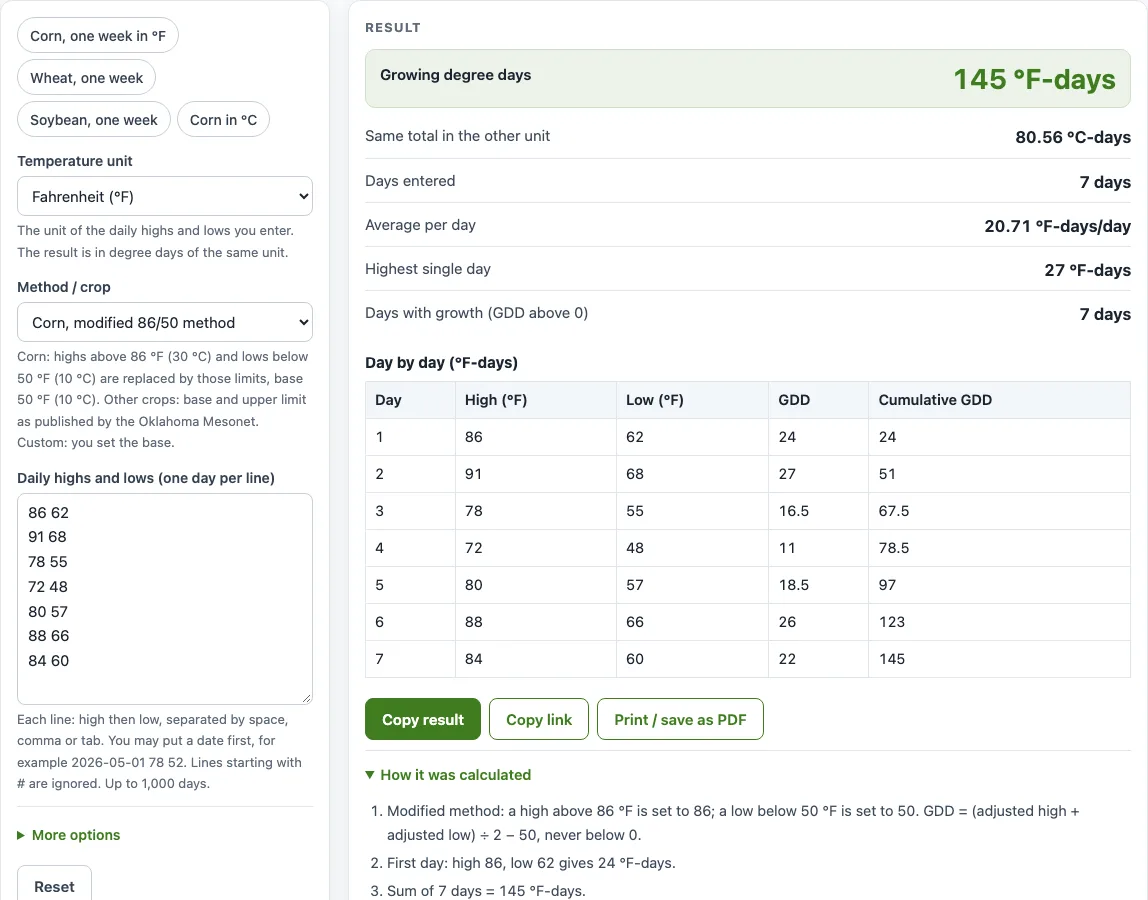
- Read the results: Growing degree days, Same total in the other unit, Days entered, Average per day, Highest single day and Days with growth (GDD above 0). The day-by-day table shows High, Low, GDD and Cumulative GDD for each day.
- Read any warning or error; errors name the problem, such as a line missing its low.
Preset buttons load sample data. Copy link keeps all your inputs, Print / save as PDF includes the date, and Reset clears the page. How it was calculated shows each step with your numbers.
How do I calculate growing degree days?
Growing degree days (GDD) measure how much warmth a day gives a crop above a base temperature, and a growing degree day calculator does this sum for every day you enter. For each day, add the high and the low, divide by two, and subtract the base. If the answer is below 0, the day counts as 0.
For example, with a high of 78 °F, a low of 52 °F and a base of 50 °F: (78 + 52) / 2 = 65, and 65 − 50 = 15 GDD. Add the daily values together to get the season total. A day that stays below the base adds nothing. With a custom base and no upper limit, this simple averaging is the method the tool uses.
What is the corn 86/50 modified method?
The corn modified 86/50 method, described by Purdue MRCC and Ohio State, adjusts the temperatures before averaging. A high above 86 °F (30 °C) is set to 86, and a low below 50 °F (10 °C) is set to 50. Then GDD = (adjusted high + adjusted low) / 2 − 50 °F (10 °C).
Purdue’s example uses a high of 92 and a low of 68. The high is set to 86, so (86 + 68) / 2 = 77, and 77 − 50 = 27 GDD. Without the cap, the same day would give 30. The cap stops very hot afternoons from inflating the total, since many crops stop growing faster above a certain temperature.
How do the soybean, wheat and other crop methods differ?
For crops other than corn, the tool uses the base and upper temperatures published by the Oklahoma Mesonet. A high above the upper limit is set to the limit, the low is used as entered, and a negative result becomes 0. Unlike the corn method, the low is not raised to a floor.
The thresholds are: alfalfa 41 / 86 °F, soybean 50 / 95 °F, sorghum and peanut 55 / 95 °F, wheat 32 / 86 °F and cotton 60 / 100 °F. For example, a wheat day with a high of 60 °F and a low of 40 °F gives (60 + 40) / 2 − 32 = 18 GDD. Choose My own base temperature if your source gives a different base.
Sources
- Purdue Midwestern Regional Climate Center, Modified growing degree days — high capped at 86 °F, low raised to 50 °F, worked example 92/68 °F
- Ohio State Weather System, GDD glossary — simple averaging method and modified method with 86 °F and 50 °F thresholds
- Oklahoma Mesonet, Degree Day Heat Units — base and upper temperatures for alfalfa, corn, cotton, peanut, sorghum, soybean and wheat, and the cutoff formula
Worked examples
| Input | Result |
|---|---|
| 7 days, corn 86/50 method, °F | 145 °F-days (20.71 per day) |
| 4 days, wheat thresholds, °F | 63.5 °F-days (15.88 per day) |
| 4 days, corn 86/50 method, °C | 43.5 °C-days (10.88 per day) |
| 3 days, base 41 °F, °F | 61 °F-days (20.33 per day) |
Calculated by the tool above with these values.
Frequently asked questions
What base temperature for corn, soybean, wheat, alfalfa?
Corn uses the modified 86/50 method, with a base of 50 °F (10 °C) and a high cap of 86 °F (30 °C). Soybean uses a base of 50 °F (10 °C) with an upper limit of 95 °F. Alfalfa uses a base of 41 °F (5 °C) and wheat a base of 32 °F (0 °C), and both have an upper limit of 86 °F.
How do I convert growing degree days between F and C?
Multiply the Celsius value by 1.8 to get Fahrenheit degree days, since 1 C-day equals 1.8 F-days. To go the other way, divide the Fahrenheit value by 1.8. The tool’s Same total in the other unit row does this conversion exactly. For example, 81 C-days equals 145.8 F-days.
How do I add up GDD over many days from daily highs and lows?
Work out each day’s GDD with the formula above, then add the results. Days below the base count as zero but still appear in Days entered. The default corn week totals 24 + 27 + 16.5 + 11 + 18.5 + 26 + 22 = 145 F-days, which you can check against the cumulative column.
What does GDU mean (growing degree units)?
GDU stands for growing degree units, a name used for the same measure as growing degree days. Heat units is another common term. A GDU total is read in the same temperature unit as the GDD total, so a Fahrenheit total is in F-days.
Is the calculator free, and is anything I type uploaded?
Yes, the calculator is free and needs no sign-up. It runs in your browser, and nothing you type is uploaded. You can copy the result, copy a link with your inputs, or print a copy for your records.
Related tools
- Grain shrink calculator: estimate how much weight grain loses when its moisture is reduced.
- Seeding rate calculator: work out how many seeds or pounds to plant per acre.
- Grain bin capacity calculator: estimate how much grain a bin can hold.
- Acreage calculator: convert field shapes and dimensions into acres.
- Fertilizer calculator: figure out fertilizer amounts for a given application rate.
- Corn nitrogen rate calculator: estimate a nitrogen rate for a corn field.
- Hay calculator: estimate hay quantities and bale totals.