Hay Calculator
Enter your animals, their weight, the feeding days and your bale size to get the tons and bales of hay you need.
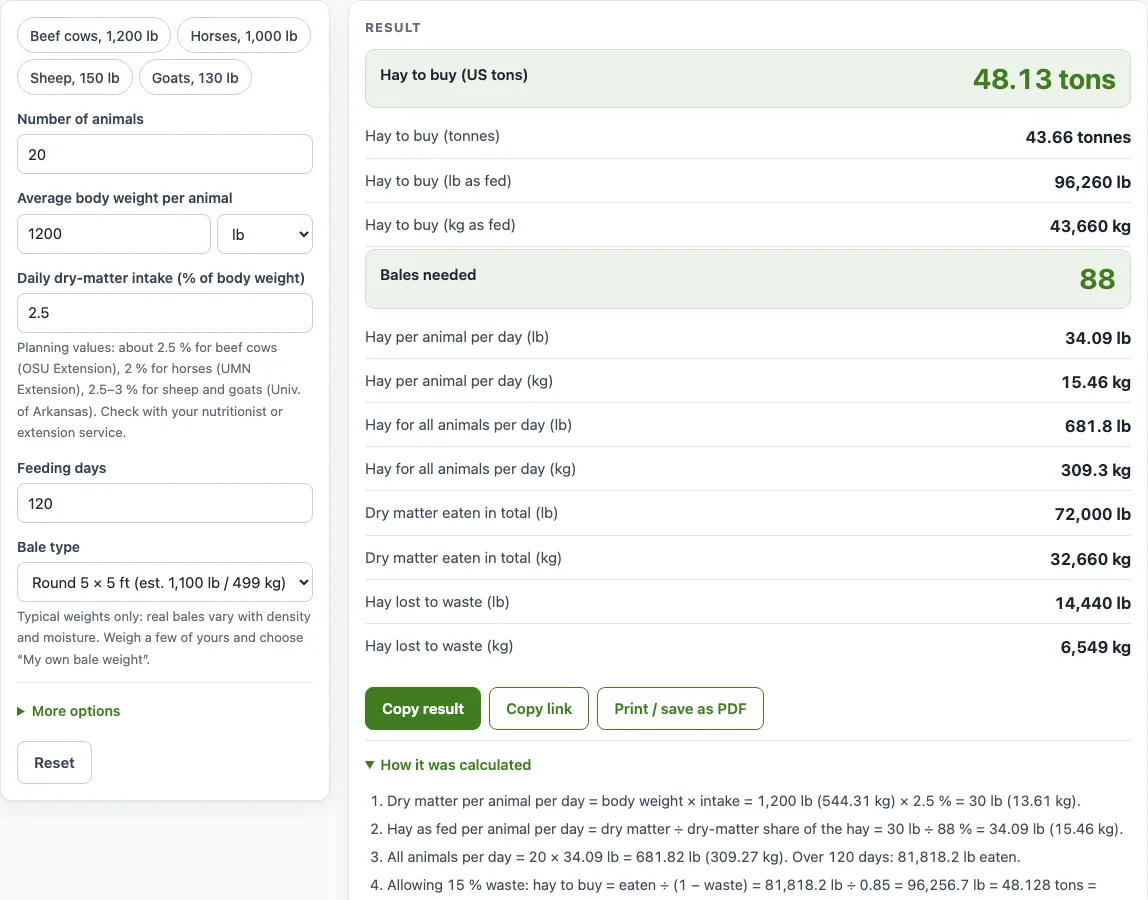
How to use the Hay Calculator
- Enter the Number of animals in the group.
- Enter the Average body weight per animal and choose lb or kg.
- Enter the Daily dry-matter intake (% of body weight). The help text gives planning values of about 2.5 % for beef cows, 2 % for horses and 2.5–3 % for sheep and goats, with the extension service each comes from.
- Enter the Feeding days, meaning how many days the hay must last.
- Choose a Bale type, from small square 2-string to round 5 × 6 ft and large square 4 × 4 × 8 ft. If you have weighed your own bales, choose “My own bale weight” and enter the Weight of one bale.
- Open More options to set Hay moisture (%), Storage and feeding waste (%) and an optional Hay price with Price is per (US ton, tonne or bale).
- Read Hay to buy (US tons), Bales needed and Hay cost if you entered a price. Open How it was calculated to see each step with your numbers, including the dry matter eaten, the hay lost to waste and the hay per animal per day.
The four example buttons (Beef cows, Horses, Sheep and Goats) fill in a typical body weight and intake that you can change. Reset restores the defaults, Copy link stores every input in the page address, Copy result copies the result lines, and Print / save as PDF prints the inputs, results and steps.
How is the amount of hay for a herd worked out?
The tool multiplies body weight by the intake percentage to get dry matter per animal per day. It divides by the dry-matter share of the hay (100 % minus moisture) to get hay as fed, then multiplies by the number of animals and the feeding days. Finally it divides by (1 − waste share) to get the hay to buy. Each step is shown under “How it was calculated”.
How much hay does a cow eat per day?
A 1,200 lb beef cow eating 2.5 % of its body weight takes in 30 lb of dry matter a day. At 12 % moisture, that is about 34 lb of hay as fed:
- Dry matter per day = 1,200 lb × 2.5 % = 30 lb
- Hay as fed per day = 30 lb ÷ 0.88 = 34.09 lb
For 20 such cows over 120 days with 15 % waste, the tool gives 96,257 lb, or 48.13 US tons (43.66 tonnes). Change the weight or intake to match your herd, and the figures update.
How many bales of hay do I need for the winter?
Divide the hay to buy by the weight of one bale, then round up to the next whole bale. In the example above, a 5 × 5 ft round bale at the 1,100 lb Texas A&M AgriLife Extension uses as its reference bale gives 87.5, rounded up to 88 bales. The bale weights in the menu are estimates, not standards: round and large square bales come from the Texas A&M table, which assumes every bale is as dense as a 1,100 lb 5 × 5 ft bale, and small squares from John Deere’s bale guide. Bale weight changes with size, density and moisture, so weighing a few of your own bales and choosing “My own bale weight” gives a better answer. This also works as a quick check on the weight of a square bale of hay, since you enter the weight yourself.
Sources
- Texas A&M AgriLife Extension E-319, Bale Weight: How Important Is It? — estimated round and large square bale weights at 11.21 lb/ft³
- John Deere, standard hay bale weights and dimensions — small square bales (2-string 50–60 lb, 3-string about 100 lb)
- OSU Beef Cattle Manual, chapter 16, UMN Extension, Hay in horse diets and University of Arkansas FSA-9613 — dry-matter intake planning values
Worked examples
| Input | Result |
|---|---|
| 20 animals × 1200 lb, 2.5 % intake, 120 days | 48.13 US tons (43.66 tonnes), 88 bales |
| 4 animals × 1000 lb, 2 % intake, 180 days | 9.091 US tons (8.247 tonnes), 364 bales |
| 50 animals × 60 kg, 3 % intake, 100 days | 12.53 US tons (11.36 tonnes), 251 bales |
| 100 animals × 600 kg, 2.5 % intake, 90 days | 198.9 US tons (180.5 tonnes), 361 bales |
| 10 animals × 1200 lb, 2.5 % intake, 30 days | 6.016 US tons (5.458 tonnes), 22 bales |
Calculated by the tool above with these values.
Frequently asked questions
Is the calculator free, and is anything I type uploaded?
Yes, it is free and needs no sign-up. It runs entirely in your browser, and nothing you type is uploaded.
Can I use the results in commercial work such as quotes and bids?
Yes. Results, steps and printouts can be used in any work, including quotes, bids and invoices, and no attribution is needed.
Which intake percentage should I use for goats or sheep?
The Sheep and Goats buttons fill in 3 %, the upper end of the 2.5–3 % of body weight in dry matter that University of Arkansas Extension gives for ruminants. Lactating does and ewes can eat more. Ask your nutritionist, veterinarian or extension service for an intake that suits your animals, hay quality and stage of production.
Why does the tool warn me about high moisture?
Hay above 20 % moisture may heat and mould in storage, and its dry-matter share is lower, so more hay is needed. Check the figure against a hay test if the warning appears. The tool also warns about an intake below 1 % or above 5 % of body weight, and a waste share above 40 %.
What hay bale weight does the calculator use?
It does not measure your bales. It uses an estimated hay bale weight for the bale type you pick, such as 50 lb for a 2-string small square or 1,100 lb for a 5 × 5 ft round bale. Enter your own weight for a more accurate bale count.
Related tools
- Cow gestation calculator: use it to plan calving dates for a breeding herd.
- Square foot to acre converter: use it to convert pasture or field areas from square feet to acres.
- Hectare to acre converter: use it to convert field sizes between hectares and acres.
- Acreage calculator: use it to work out the area of a field or pasture.
- Acre per hour calculator: use it to estimate how long a field job will take.
- Fertilizer calculator: use it to plan fertilizer rates for pasture or crop ground.
- Lawn fertilizer calculator: use it to plan fertilizer for a lawn.
- Egg incubation calculator: use it to plan the hatch date and lockdown day for poultry eggs.
- All calculators: use it to browse every calculator on the site.