Irrigation Calculator
Work out drip zone flow and run time, the application rate of a system, or the velocity in an irrigation pipe.
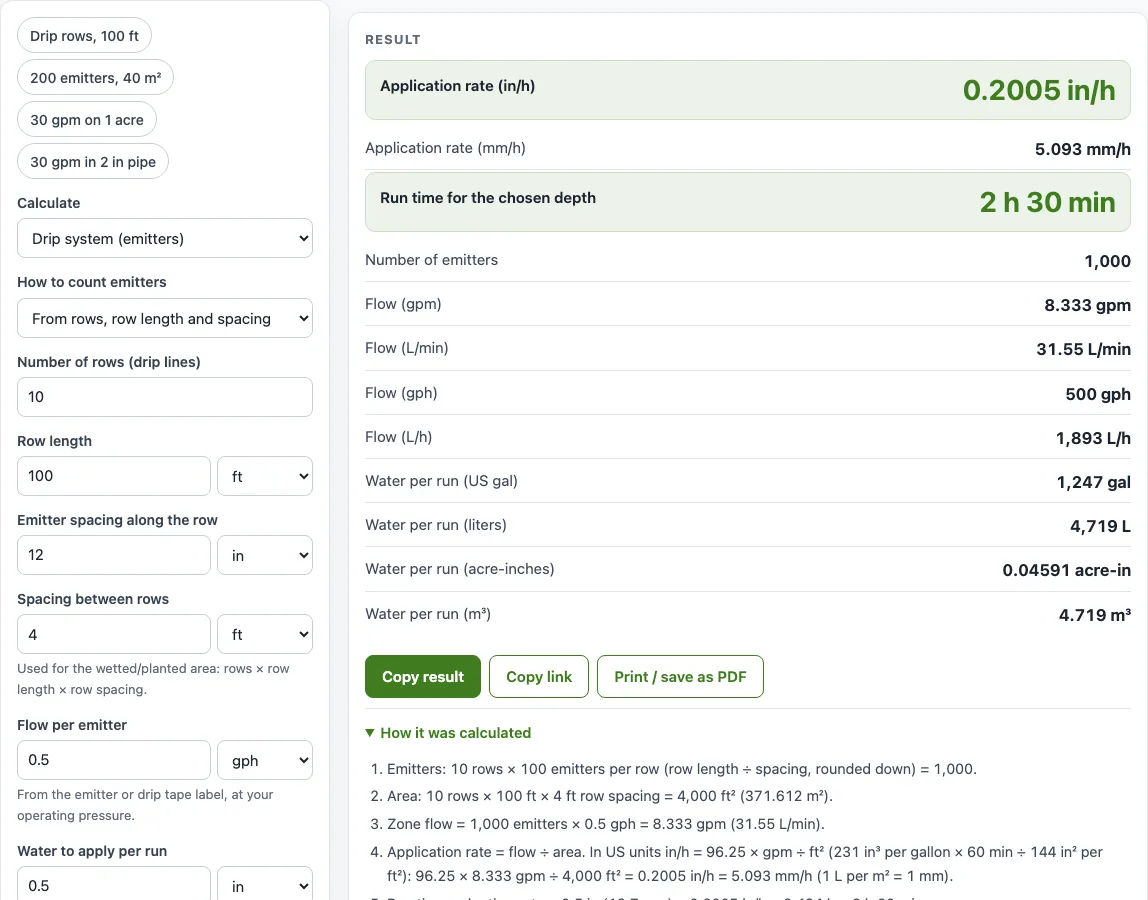
How to use the Irrigation Calculator
- In Calculate, choose “Drip system (emitters)”, “Flow over an area (sprinkler, pivot, flood)” or “Pipe velocity and size”.
- For drip, set How to count emitters to “From rows, row length and spacing” or “I know the number of emitters”.
- If you count from rows, enter Number of rows (drip lines), Row length, Emitter spacing along the row and Spacing between rows. Otherwise enter Number of emitters and the Wetted or planted area.
- Enter Flow per emitter (gph, L/h, gpm or L/min) from the emitter or drip tape label.
- For flow over an area, enter Water flow and the Wetted or planted area.
- For pipe sizing, enter Water flow, Pipe inside diameter and Maximum velocity.
- To get run time and total volume, enter Water to apply per run. Leave it blank to skip them.
- Under More options, set Application efficiency (%) if you expect losses. 100 means none.
- Read the results, such as the application rate, run time, water per run, velocity or smallest inside diameter, then check any warnings and open How it was calculated to see the steps.
The example buttons load samples. Reset restores the defaults, Copy link stores every input in the page address, Copy result copies the result lines, and Print / save as PDF prints the inputs and steps with the date.
How do you calculate drip irrigation run time?
Divide the depth of water you need by the application rate. The application rate is the zone flow divided by the wetted area.
For example, 10 rows of 100 ft with an emitter every 12 in gives 1,000 emitters. At 0.5 gph each, the zone flow is 500 gph, or 8.333 gpm. The area is 10 rows × 100 ft × 4 ft row spacing = 4,000 ft². The rate is 96.25 × 8.333 ÷ 4,000 = 0.2005 in/h (5.093 mm/h). The constant 96.25 comes from 231 in³ per gallon × 60 min ÷ 144 in² per ft². To apply 0.5 in, the run time is 0.5 ÷ 0.2005 = 2.494 hours, shown as 2 h 30 min, using 1,246.8 US gallons.
With efficiency below 100 %, the tool divides the depth by it. At 75 %, the same example needs 3 h 19 min.
What size pipe do I need for irrigation?
Pipe velocity is the flow divided by the inside cross-section area. The tool also gives the smallest inside diameter that keeps velocity at or below your maximum.
For example, 30 gpm in a 2 in pipe gives 3.064 ft/s (0.9338 m/s). The Maximum velocity field starts at 5 ft/s (1.5 m/s), a design limit often used for plastic irrigation pipe, but you can change it and should check the pipe maker’s guidance. At 5 ft/s the smallest inside diameter for 30 gpm is 1.566 in (39.77 mm). If the velocity is above your limit, the tool warns you. Use the inside diameter, not the nominal size.
How do you convert flow over an area into an application rate?
Multiply gpm by 96.25 and divide by the area in square feet to get inches per hour. In metric, 1 mm of water on 1 m² is 1 liter.
For example, 30 gpm over 1 acre (43,560 ft²) gives 0.06629 in/h (1.684 mm/h). To apply 1 in, the run time is 15 h 5 min and the volume is 27,154 gal, which is one acre-inch. A rate above 3 in/h triggers a warning that many soils cannot absorb water that fast. Check your soil intake rate.
Sources
- NIST Handbook 44, Appendix C and NIST SP 811 — exact unit definitions (1 acre = 43,560 ft² = 4,046.8564224 m², 1 lb = 0.45359237 kg, 1 US gal = 231 in³); 1 acre-inch = 3,630 ft³ ≈ 27,154 gal
- UF/IFAS Extension AE066 and USDA NRCS irrigation pipeline criteria — 5 ft/s velocity limit for plastic irrigation pipe
Worked examples
| Input | Result |
|---|---|
| 1,000 emitters at 0.5 gph | 0.2005 in/h (5.093 mm/h), 2 h 30 min to apply 0.5 in |
| 200 emitters at 2 L/h | 0.3937 in/h (10 mm/h), 1 h 0 min to apply 10 mm |
| 30 gpm, 1 acre | 0.06629 in/h (1.684 mm/h), 15 h 5 min to apply 1 in |
| 120 m³/h, 5 ha | 0.09449 in/h (2.4 mm/h), 10 h 25 min to apply 25 mm |
| 30 gpm, 2 in | velocity 3.064 ft/s (0.9338 m/s); at least 1.57 in inside diameter for the limit |
Calculated by the tool above with these values.
Frequently asked questions
Is the calculator free, and is anything I type uploaded?
Yes, it is free. It runs entirely in your browser, needs no sign-up, and nothing you type is uploaded.
Can I use the results in commercial work such as quotes and bids?
Yes. Results, steps and printouts can be used in any work, including quotes and invoices, and no attribution is needed. They are planning estimates, so check them against the product label and your equipment.
What does application efficiency do?
It adds water to cover losses. 100 means no losses. If you lower it, the calculator divides the depth by it, so the water volume and run time go up to match. For example, 75 % turns a 0.5 in net depth into 0.667 in applied.
Does the calculator tell me how much water my crop needs?
No. The depth you enter should come from your soil, the crop, an agronomist or your extension service. The tool only converts that depth into run time and volume.
Can I use it for a center pivot?
Only in a limited way. Use the “Flow over an area” mode with the pivot’s flow and the area it covers to get the average application rate. The tool does not model the pivot’s travel speed or sprinkler package.
Related tools
- Sprinkler calculator: use it when you are planning sprinkler coverage and output rather than drip emitters.
- Square foot to acre converter: use it to convert a wetted or planted area from square feet to acres.
- Hectare to acre converter: use it to convert an area between hectares and acres.
- Acreage calculator: use it to work out the area of a field or plot before entering it.
- Acre per hour calculator: use it to estimate how many acres you can cover in an hour.
- Fertilizer calculator: use it to work out fertilizer amounts for a field or garden.
- Lawn fertilizer calculator: use it when you are working out fertilizer for a lawn.
- Irrigation system design calculator: use it to size system flow, pipe friction and pump pressure.
- All calculators: use it to browse every calculator on the site.