Irrigation System Design Calculator
Enter the area, peak water use and your pipe to get the system flow, pipe velocity, friction loss and the pressure the pump must deliver.
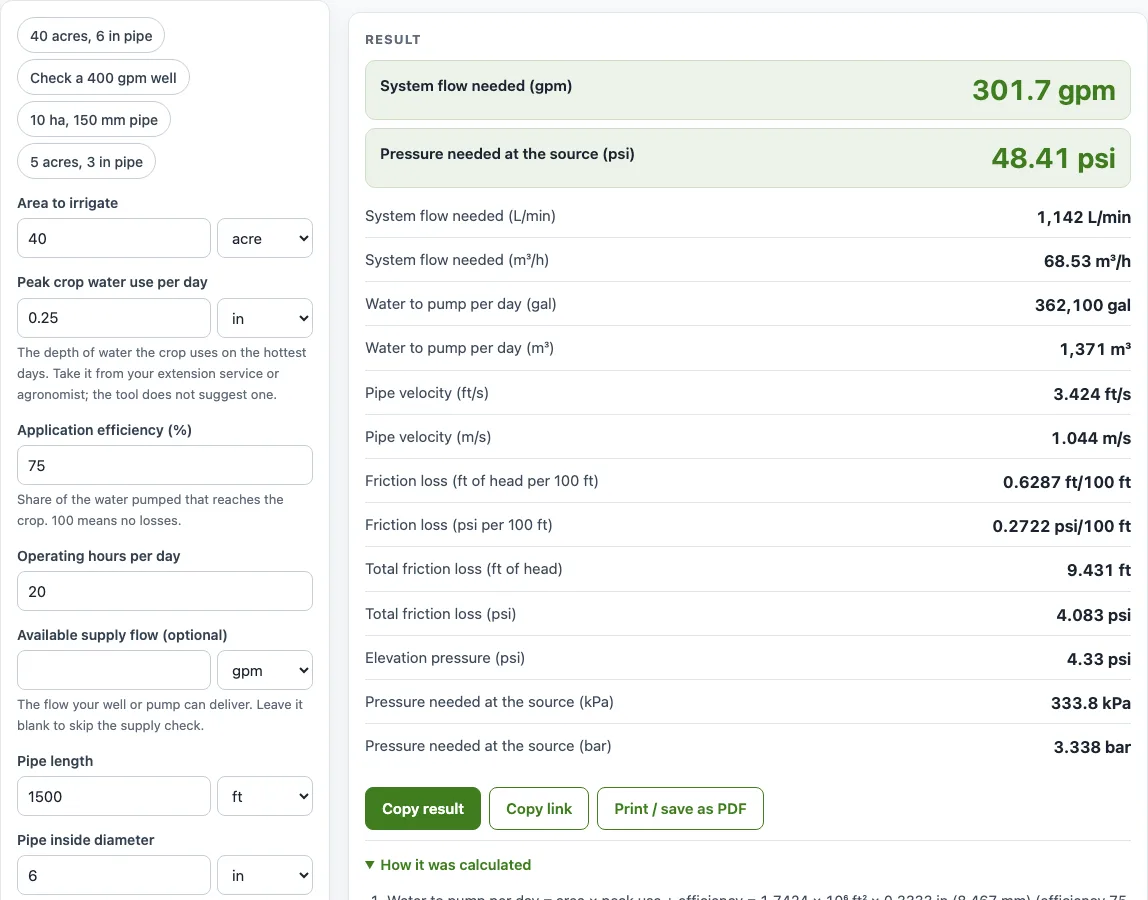
How to use the Irrigation System Design Calculator
- Enter the Area to irrigate in acres, hectares, square feet or square meters.
- Enter the Peak crop water use per day in inches or millimeters. Take the number from your extension service or agronomist.
- Set the Application efficiency (%). 100 means no losses; sprinklers and drip lose different amounts.
- Enter the Operating hours per day, up to 24.
- Optionally enter the Available supply flow of your well or pump to see how many hours a day it must run.
- Enter the Pipe length, Pipe inside diameter and the Pressure needed at the end of the pipe, from the sprinkler or emitter data sheet.
- Enter the Elevation gain from source to end of pipe. Use a negative number for a downhill run.
- Under More options, set the Pipe roughness coefficient (C) (150 for PVC) and any Fittings allowance.
- Read the system flow and the pressure needed at the source, then check any warnings and open How it was calculated to see each step.
The example buttons load samples. Reset restores the defaults, Copy link stores your inputs in the page address, Copy result copies the result lines, and Print / save as PDF prints the inputs and steps with the date.
How do you size an irrigation system?
Start with the water to apply per day, then divide by the hours the system runs. For 40 acres with a peak use of 0.25 in/day and 75 % efficiency, the gross depth is 0.25 ÷ 0.75 = 0.3333 in/day. One acre-inch is 27,154 gallons, so the daily volume is 40 × 0.3333 × 27,154 = 362,057 gallons. Over 20 hours (1,200 minutes) that is 301.7 gpm. This is the flow if the whole field is watered at once. If your supply is smaller, the same volume just takes longer to pump.
Can my well keep up?
Enter the supply flow and the tool divides the daily volume by it. A 400 gpm well pumps 362,057 gallons in 15 h 5 min, inside the 20 hours set. A 200 gpm well needs 30.2 hours, more than a day, so it cannot meet this peak use without a smaller area, storage or lower use. The tool warns you in both cases.
How do you calculate friction loss in irrigation pipe?
The tool uses the Hazen-Williams equation as printed in the Irrigation Systems Management course text: friction loss = 1054 × (Q ÷ C)^1.852 ÷ d^4.866 feet of head per 100 feet, with Q in gpm and d the inside diameter in inches. With 301.7 gpm in a 6 in pipe and C = 150 for PVC, the loss is 0.6287 ft per 100 ft. Over 1,500 ft that is 9.43 ft of head, or 4.08 psi at 0.433 psi per foot. The same flow in a 4 in pipe would move at 7.7 ft/s, above the 5 ft/s limit often used for plastic pipe, and the tool warns you. This version assumes no outlets along the pipe.
What pressure does the pump need?
The pressure at the source is the pressure needed at the end plus friction loss plus elevation. In the default case: 40 psi + 4.08 psi + 10 ft × 0.433 = 4.33 psi, giving 48.41 psi (333.8 kPa). A downhill run subtracts pressure. Add your own allowance for valves, filters and fittings with the fittings box, or enter it separately.
Sources
- Irrigation Systems Management (AET 021), “Computing Losses Due to Friction” — Hazen-Williams equations 8.11a and 8.11b and the C values in Table 8.1 (PVC 150; read 2026-10-17)
- NIST SP 811 and NIST Handbook 44, Appendix C — 1 acre = 43,560 ft², 1 US gal = 231 in³; 1 acre-inch ≈ 27,154 gal
- UF/IFAS Extension AE066 and USDA NRCS irrigation pipeline criteria — 5 ft/s velocity limit for plastic irrigation pipe
Worked examples
| Input | Result |
|---|---|
| 40 acre, 0.25 in/day, 1500 ft of 6 in pipe | 301.7 gpm needed, 48.41 psi at the source |
| 40 acre, 0.25 in/day, 1500 ft of 6 in pipe | 301.7 gpm needed, 48.41 psi at the source |
| 10 ha, 6 mm/day, 600 m of 150 mm pipe | 194.2 gpm needed, 53.18 psi at the source |
| 5 acre, 0.2 in/day, 800 ft of 3 in pipe | 50.29 gpm needed, 25.8 psi at the source |
Calculated by the tool above with these values.
Frequently asked questions
Is the calculator free, and is anything I type uploaded?
Yes, it is free. It runs in your browser, needs no sign-up, and nothing you type is uploaded.
Can I use the results in commercial work such as quotes and bids?
Yes. Results, steps and printouts can be used in any work, including quotes and bids, and no attribution is needed. They are planning estimates, so have a designer check a real installation.
Does it tell me how much water my crop needs?
No. Enter the peak daily use from your extension service, agronomist or local weather data. The tool only turns that depth into flow and pressure.
What C value should I use?
The course text lists 150 for PVC, 140 for galvanized steel, 120 for aluminum pipe with couplers and 100 for standard steel. The default is 150. Use the pipe maker’s value if you have one.
Does it handle sprinklers along the pipe or several zones?
Not directly. It assumes the flow travels the whole length of the pipe, which is a conservative case for a main line. For a lateral with outlets along it, or for zones, run the main and each lateral as separate cases.
How is this different from the irrigation calculator?
The irrigation calculator converts drip emitter or sprinkler flow into an application rate and run time and checks pipe velocity. This tool starts with the field and peak use, then adds friction loss, elevation and the pump pressure.
Related tools
- Irrigation calculator: use it for drip flow, run time and application rate.
- Sprinkler calculator: use it for precipitation rate and heads per zone.
- Pond volume calculator: use it to find how much water a pond or storage holds.
- Acreage calculator: use it to find the area of the field before entering it.
- Square foot to acre converter: use it to convert an area from square feet to acres.
- Hectare to acre converter: use it to convert an area between hectares and acres.
- Sprayer calibration calculator: use it to calibrate a sprayer in gallons per acre.
- All calculators: use it to browse every calculator on the site.