Lime Calculator (Lime per Acre)
Enter the soil-test lime recommendation and your product's quality to get the rate per acre or per 1,000 sq ft and the total.
The Lime calculator estimates how much lime to spread on an area and how many bags you will need. Enter your soil test lime recommendation, the lime’s quality, and the area, and the tool shows the rate and total amount of lime to buy. It is free, runs entirely in your browser, and needs no sign-up.
Use it for acreage, such as a per-acre ag lime rate, or for smaller areas like a lawn, yard, or food plot measured in square feet or square meters. It also works with dolomitic, hydrated, and pelletized lime, as long as you have the quality value from the tag or analysis. Results are planning figures, so check them against the product label and your soil test.
How to use the Lime calculator
- Enter the lime recommendation in Lime recommendation (as pure CaCO₃). Use the figure from your soil test report, and pick its unit: ton/acre, lb/1,000 ft², t/ha, kg/ha, or lb/acre.
- Open Product quality given as and choose the option that matches your lime tag: ECCE %, CCE % and fineness %, or ENP (lb per ton).
- Fill in the fields that match that choice. For ECCE, enter ECCE (%). For CCE and fineness, enter CCE (%) and Fineness efficiency (%). For ENP, enter ENP (lb/ton).
- Enter the size of the field in Area to lime and pick its unit: acre, ha, ft², or m².
- Choose the Bag size you will buy: 40 lb, 50 lb, or 25 kg.
- Optional: under More options, fill in the two depth fields (see the explanation below).
- Read the results: Lime to apply, Total lime for the area, Bags needed, and Quality used. Check for any warning shown above the results.
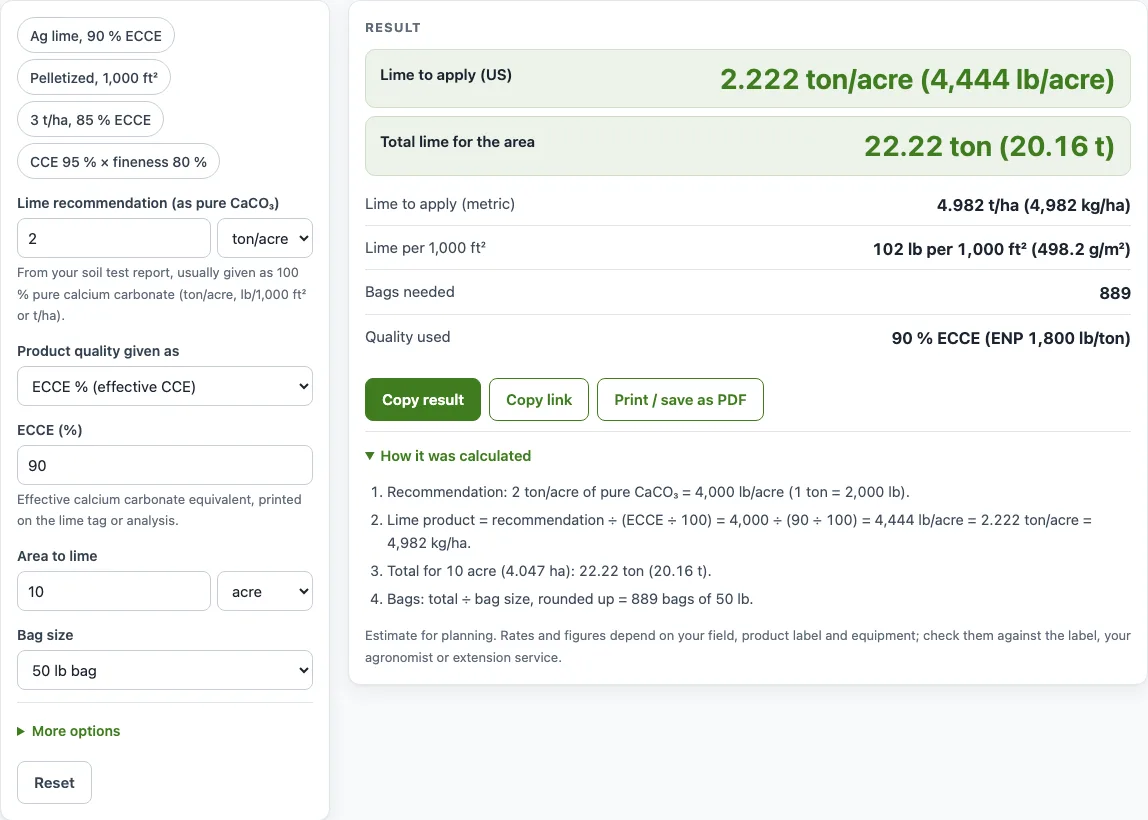
The example buttons above the form load sample values, such as “Ag lime, 90 % ECCE”, “Pelletized, 1,000 ft²”, “3 t/ha, 85 % ECCE” and “CCE 95 % × fineness 80 %”. Copy result copies the results, and Copy link copies a page address that reopens the same inputs. Print / save as PDF prints the inputs, results, calculation steps, and date. Reset restores the default values.
How much lime do I need per acre?
Your soil test gives a recommended amount of pure calcium carbonate (CaCO₃), which is 100 % effective lime. Lime products are rarely pure, so you need more product than the recommendation. Divide the recommendation by the product’s ECCE as a fraction: product needed = recommendation ÷ (ECCE ÷ 100).
For example, 2 tons per acre recommended with a 70 % ECCE ag lime needs 2 ÷ 0.70 = 2.86 tons per acre. The tool’s default example works the same way: 2 ton/acre of CaCO₃ at 90 % ECCE gives 4,000 ÷ 0.90 = 4,444 lb/acre, or 2.222 ton/acre.
What is ECCE in lime?
ECCE stands for effective calcium carbonate equivalent. It is the single figure that tells you how much of the lime will neutralize soil acidity in a useful time. It combines two things: the lime’s purity, shown as CCE (calcium carbonate equivalent, compared with pure CaCO₃ = 100 %), and its fineness, which is how much of the material is fine enough to react quickly.
If your tag gives CCE and fineness separately, the tool combines them for you. If it gives ENP instead, the two are linked: ENP (lb per ton) = ECCE % × 20. A 90 % ECCE lime therefore has an ENP of 1,800 lb per ton.
How does the depth setting change the rate?
The depth fields are optional. Enter the depth your recommendation assumes in Depth the recommendation assumes, and the depth you will work the lime in under Depth you will work the lime in. The tool scales the rate in proportion to these two depths. If you plan to mix the lime into a deeper layer than the recommendation assumed, the rate rises in the same proportion, and if you work it in shallower, the rate falls.
Sources
- Minnesota Department of Agriculture, Ag lime analysis and UMN Extension, Liming materials — CCE × fineness, ENP in lb per ton
- Texas A&M AgriLife (Overton), effective liming material — ECCE × 20 = lb per ton
- NIST Handbook 44, Appendix C and NIST SP 811 — exact unit definitions (1 acre = 43,560 ft² = 4,046.8564224 m², 1 lb = 0.45359237 kg, 1 US gal = 231 in³)
Worked examples
| Input | Result |
|---|---|
| 2 ton/acre as CaCO₃, 90 % ECCE, 10 acre | 2.222 ton/acre (4,444 lb/acre); 22.22 ton (20.16 t) |
| 3 t/ha as CaCO₃, 85 % ECCE, 4 ha | 1.574 ton/acre (3,149 lb/acre); 15.56 ton (14.12 t) |
| 1.5 ton/acre as CaCO₃, 76 % ECCE, 5 acre | 1.974 ton/acre (3,947 lb/acre); 9.868 ton (8.952 t) |
| 50 lb/1,000 ft² as CaCO₃, 95 % ECCE, 1000 ft² | 1.146 ton/acre (2,293 lb/acre); 52.63 lb (23.87 kg) |
| 2 ton/acre as CaCO₃, 90 % ECCE, 10 acre | 2.963 ton/acre (5,926 lb/acre); 29.63 ton (26.88 t) |
Calculated by the tool above with these values.
Frequently asked questions
Is the calculator free, and is anything I type uploaded?
Yes, the calculator is free, runs entirely in your browser, and needs no sign-up. Nothing you type is uploaded.
Can I use the results in commercial work such as quotes and bids?
Yes. Results, steps, and printouts may be used in any work, including commercial work such as nutrient plans, quotes, and invoices. No attribution is needed.
Why does the calculator warn about an ECCE above 110 %?
An ECCE above about 110 % is only possible for burnt or hydrated lime. If you entered a higher value for an ag or ground limestone product, check the figure on the lime tag before you use the result.
Can I use it for hydrated or dolomitic lime?
Yes, if you know the product’s quality value. Enter its ECCE, or its CCE and fineness, or its ENP from the tag. The calculator does not check the type of lime, so it cannot say which kind your soil needs.
Do I have to fill in both depth fields?
Yes. The depth adjustment applies only when both depths are entered. Leave both empty to use the recommendation as given.
Does the calculator tell me how much lime my soil needs?
No. The calculator does not recommend rates. It converts a recommendation you already have into product amounts. The product label, a soil test, an agronomist, or your extension service gives the actual recommendation.
Related tools
- Fertilizer calculator: use it to work out product amounts for other nutrients once your lime is planned.
- Lawn fertilizer calculator: use it to plan fertilizer for a lawn after you have limed the area.
- Square foot to acre converter: use it to convert a lawn or yard size in square feet into acres.
- Hectare to acre converter: use it to convert field sizes between hectares and acres.
- Acreage calculator: use it to work out the size of a field from its dimensions.
- Acre per hour calculator: use it to estimate how long spreading the lime will take.
- Seeding rate calculator: use it to plan seed amounts for an area you are preparing.
- All calculators: use it to browse every tool on the site.