Seeding Rate Calculator
Enter the plant stand you want, germination and seed size to get seeds and pounds per acre, or work out plant population from spacing.
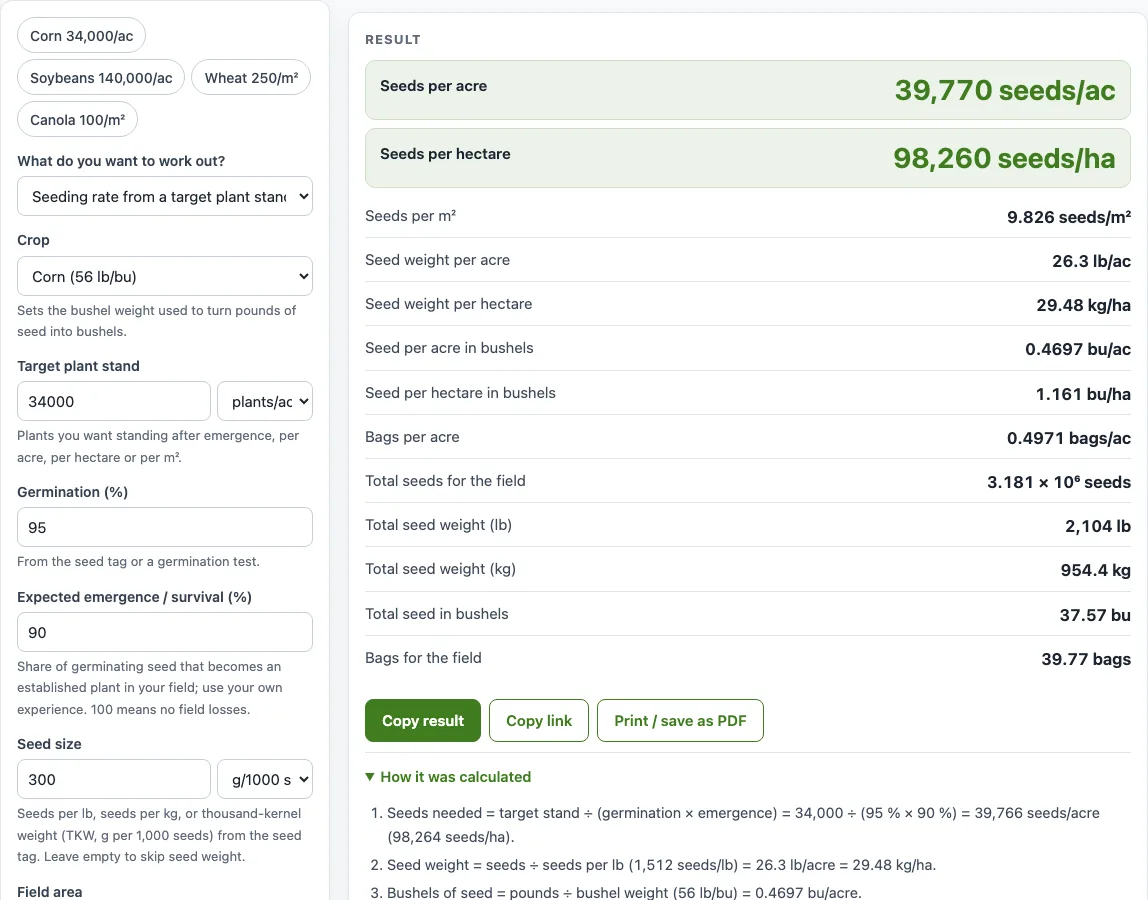
How to use the Seeding rate calculator
- In What do you want to work out?, choose one of three options: “Seeding rate from a target plant stand”, “Plant population from row and seed spacing”, or “Seed spacing for a target stand”.
- In Crop, pick your crop. This sets the bushel weight used for bushel results. Choose “Other (no bushels)” for crops without a standard bushel weight.
- Enter the Target plant stand and select its unit: plants/ac, plants/ha or plants/m².
- Enter Germination (%) from the seed tag or a germination test.
- Enter Expected emergence / survival (%) based on your own field experience. A value of 100 assumes no field losses.
- For the spacing options, enter Row spacing and Seed spacing in the row in inches or cm.
- Enter Seed size as seeds/lb, seeds/kg or TKW (g per 1,000 seeds) from the seed tag, or leave it empty.
- Optionally, enter Field area to get totals for the whole field.
- Under More options, enter seeds per bag and price per bag to get bag counts and seed cost.
- Read the results, then check How it was calculated to see each step with your numbers.
Fields such as target stand, spacing and seed size have unit menus, and results show US and metric. The example buttons load “Corn 34,000/ac” and three other crops. Copy result copies the results, and Copy link copies a page address that reopens the same inputs. Print / save as PDF prints the inputs, results, steps and date. Reset restores the default values.
How do you calculate seeding rate?
Seeding rate is the number of seeds to plant so that enough of them become established plants. Divide the target plant stand by the share of seeds that survive: seeds needed = target stand ÷ (germination × emergence). Both percentages are converted to fractions first, so 95% × 90% = 0.855.
Using the tool’s default values: 34,000 plants/ac ÷ 0.855 = 39,766 seeds/ac, or about 98,264 seeds/ha.
Seed weight comes next. Pounds per acre = seeds ÷ seeds per pound. With 1,512 seeds per lb, 39,766 ÷ 1,512 = 26.3 lb/ac, which equals 29.48 kg/ha. Bushels are pounds divided by the bushel weight. For corn at 56 lb/bu, 26.3 ÷ 56 = 0.4697 bu/ac. Bags are seeds divided by seeds per bag. At 80,000 seeds per bag, 39,766 ÷ 80,000 = 0.4971 bags/ac. For field totals, the tool multiplies the per-acre values by the field area. The default example uses 80 acres, which is 32.375 ha, so it needs about 3.18 million seeds, 2,104 lb of seed, or 39.8 bags.
If you know thousand-kernel weight instead of seeds per pound, use kg/ha = seeds per ha × TKW ÷ 1,000,000.
How do you calculate plant population?
Plant population is the number of plants per unit of area, and it comes from your row and seed spacing. The tool first finds seeds per acre and then applies your germination and emergence percentages to show the expected plants. An acre contains 43,560 × 144 = 6,272,640 square inches, so seeds per acre = 6,272,640 ÷ (row width in inches × seed spacing in inches).
For example, with 30 in rows and seeds spaced 6.8 in apart in the row, 30 × 6.8 = 204 square inches per seed. Then 6,272,640 ÷ 204 = 30,748 seeds per acre, or about 75,981 per hectare. With 95% germination and 90% emergence, about 26,290 of those seeds become plants per acre.
The spacing option works in reverse. Seed spacing needed for a target stand = 6,272,640 ÷ (row width × seeds per acre). Seeds per acre comes from the seeding rate calculation above, so the germination and emergence values still apply.
Sources
- Iowa State University Extension CROPR 3161, Guide to Iowa Corn Planting — seeding rate and plant population
- USDA ERS Agricultural Handbook 697 — standard bushel weights (corn 56, soybeans 60, wheat 60, barley 48, oats 32, sorghum 56, rye 56 lb)
- MSU Extension, Maximizing returns on soybean seed investments — 140,000-seed soybean units
- NIST Handbook 44, Appendix C and NIST SP 811 — exact unit definitions (1 acre = 43,560 ft² = 4,046.8564224 m², 1 lb = 0.45359237 kg, 1 US gal = 231 in³)
Worked examples
| Input | Result |
|---|---|
| 34000 plants/ac, 95% / 90% | 39,770 seeds/ac (98,260 seeds/ha), 26.3 lb/ac |
| 140000 plants/ac, 92% / 88% | 172,900 seeds/ac (427,300 seeds/ha), 61.8 lb/ac |
| 250 plants/m², 95% / 85% | 1.253 × 10⁶ seeds/ac (3.096 × 10⁶ seeds/ha), 110 lb/ac |
| 100 plants/m², 95% / 60% | 710,000 seeds/ac (1.754 × 10⁶ seeds/ha), 6.26 lb/ac |
| 30 in × 6.8 in | 30,750 seeds/ac (75,980 seeds/ha) |
| 34000 plants/ac, 95% / 90% | 5.27 in (13.4 cm) |
Calculated by the tool above with these values.
Frequently asked questions
Is the calculator free, and is anything I type uploaded?
Yes, the calculator is free and needs no sign-up. It runs entirely in your browser, and nothing you type is uploaded.
Can I use the results in commercial work such as quotes and bids?
Yes. Results, steps and printouts may be used in any work, including commercial work such as nutrient plans, quotes and invoices. No attribution is needed.
Why does the tool warn that my germination is low?
The tool shows this warning when germination is below 85 %, so you can check the seed tag or run a germination test before planting. A low value means more seed is needed to reach the same stand, so the calculated rate rises.
Do I have to enter the seed size?
No. Leave “Seed size” empty and the tool still gives seeds per acre and per hectare, but it skips seed weight and bushels. Bags need the “Seeds per bag or seed unit” value under More options.
What if my crop is not in the Crop list?
Select “Other (no bushels)”. The tool still calculates seeds, pounds or kilograms, and bags, but it does not show bushel results because “Other” has no standard bushel weight. Enter your own seed size so the weight results are accurate.
Related tools
- Fertilizer calculator: use it to work out nutrient rates for the same field once you have your planting plan.
- Sprayer calibration calculator: use it to check how much product your sprayer applies per acre.
- Acreage calculator: use it to measure field area before you enter totals.
- Acre per hour calculator: use it to estimate how long a field will take to cover with your equipment.
- Hectare to acre converter: use it to switch quickly between hectares and acres.
- Square foot to acre converter: use it when your field measurements are in square feet.
- Growing degree days calculator: use it to track heat units after planting.
- Corn yield calculator: use it to estimate yield from ear counts later in the season.
- All calculators: use it to browse every calculator on this site.