Soybean Yield Calculator
Enter a plant count, pods per plant, seeds per pod and seed size to estimate soybean yield per acre in bushels and tonnes per hectare.
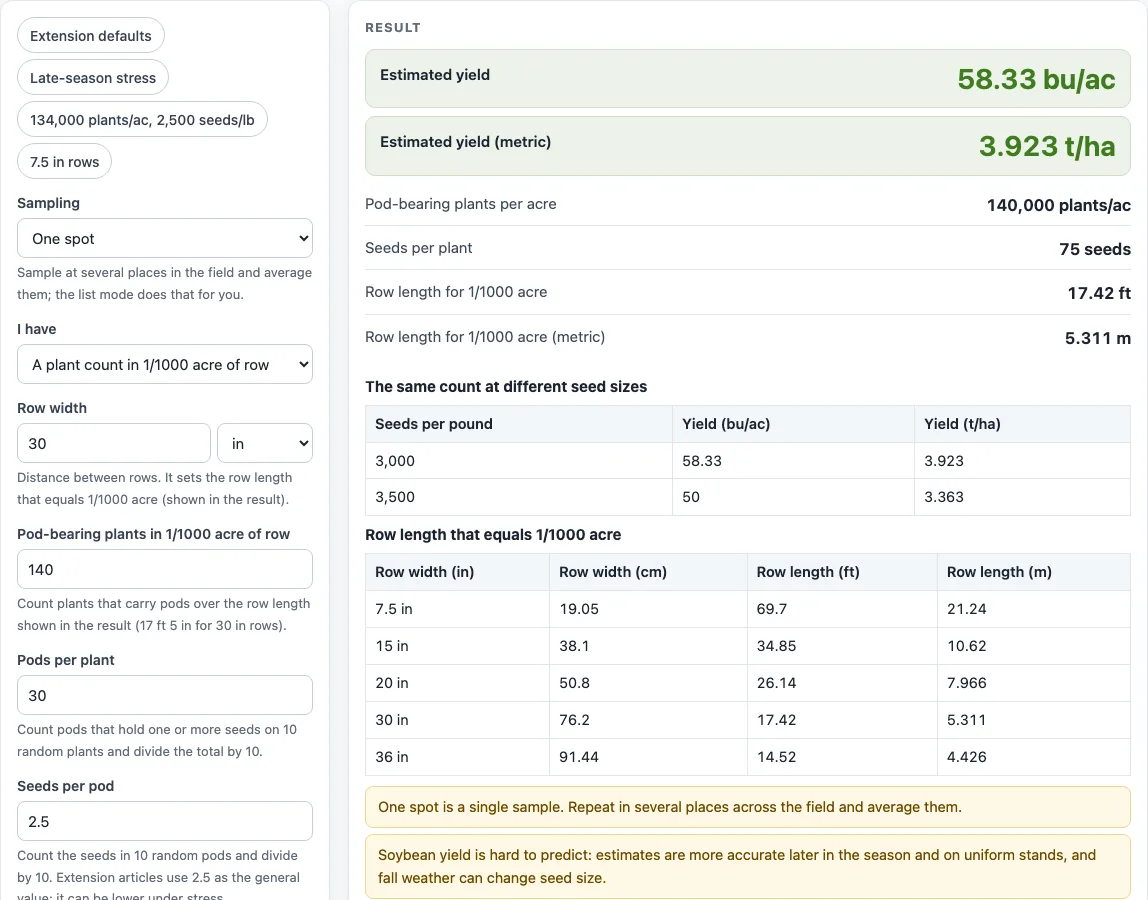
How to use the Soybean yield calculator
- Set Sampling to One spot or Several spots (list).
- For one spot, set I have to A plant count in 1/1000 acre of row or Plants per acre.
- Enter Row width in inches or centimetres. The calculator shows the Row length for 1/1000 acre.
- Enter Pod-bearing plants in 1/1000 acre of row or Pod-bearing plants per acre, depending on your choice in step 2.
- For one spot, enter Pods per plant: count pods with one or more seeds on 10 random plants, divide by 10.
- Enter Seeds per pod (one spot): count seeds in 10 random pods, divide by 10.
- Enter Seeds per pound. The default is 3,000. Use 3,500 for late-season stress.
- For several spots, enter Sampling spots (one per line) with one line per spot in the form
plants podsPerPlant seedsPerPod. Up to 200 lines; the spot yields are averaged. - Read Estimated yield and Estimated yield (metric). A table shows 3,000 and 3,500 seeds per pound, plus your value if different.
The preset buttons fill in example values: Extension defaults, Late-season stress, 134,000 plants/ac, 2,500 seeds/lb, and 7.5 in rows. Copy link keeps all your inputs, Copy result copies the answer, and Print / save as PDF prints inputs, results, steps and the date. How it was calculated shows each step; Reset clears the form.
How do I estimate soybean yield per acre before harvest?
Count the plants, pods and seeds in a sample of the field, then run the counts through the yield formula. The calculator follows the yield component method from Ohio State and Iowa State Extension.
Sample several spots across the field if the stand is uneven. Each spot gives its own estimate, and the average is the field estimate. The lowest and highest spot values show how much the field varies.
What is the soybean yield formula (plants, pods, seeds per pod, seeds per pound)?
The formula is:
bu/ac = (pod-bearing plants per 1/1000 acre × pods per plant × seeds per pod) ÷ (seeds per pound × 0.06)
Multiply the three counts to get the seeds in 1/1000 acre, then divide by the seeds per bushel (seeds per pound × 0.06, because the count covers 1/1000 acre). For example, 140 plants × 30 pods × 2.5 seeds = 10,500 seeds. At 3,000 seeds per pound, 3,000 × 0.06 = 180, so 10,500 ÷ 180 = 58.33 bu/ac, or 3.92 t/ha.
How many plants do I count in 1/1000 acre in 30 inch (15 inch, 7.5 inch) rows?
A 1/1000 acre area is 43.56 square feet. Divide that by the row width in feet to get the row length you must check. In 30 inch rows, count plants along 17.42 ft (17 ft 5 in). In 15 inch rows, count along 34.85 ft (34 ft 10 in). In 7.5 inch rows, count along 69.70 ft (69 ft 8 in).
How many seeds per pod and seeds per pound should I use?
Seeds per pod comes from your own sample: count the seeds in 10 random pods and divide by 10. Extension articles use 2.5 seeds per pod in general, and a lower number is common under stress.
Seeds per pound defaults to 3,000, which is the Ohio State and Iowa State assumption. Use 3,500 when late-season stress is expected, because stressed seeds are smaller and more seeds fill each pound.
Why divide by 60 (pounds per bushel)?
A bushel of soybeans weighs 60 lb (USDA ERS AH-697), at market moisture of 13 %. The 0.06 in the formula is 60 ÷ 1,000: 60 lb per bushel, divided by 1,000 because the plant count covers 1/1000 acre.
Sources
- Ohio State Extension C.O.R.N. Newsletter, Estimating Soybean Yield — the formula with the 0.06 factor, 2.5 seeds per pod, 3,000 and 3,500 seeds per pound, row lengths for 1/1000 acre
- Iowa State Extension, Soybean Yield Estimates — the four yield components, how to sample plants and pods
- USDA ERS Agricultural Handbook 697 — soybeans weigh 60 lb per bushel
- Penn State Extension, Understanding grain discount schedules — market moisture for soybeans is 13 %
Worked examples
| Input | Result |
|---|---|
| 140 plants per 1/1000 ac, 30 pods, 2.5 seeds per pod, 3000 seeds/lb | 58.33 bu/ac (3.92 t/ha) |
| 134000 plants/ac, 24 pods, 2.8 seeds per pod, 2500 seeds/lb | 60.03 bu/ac (4.04 t/ha) |
| 3 spots, 3500 seeds/lb | 50.87 bu/ac (3.42 t/ha) |
Calculated by the tool above with these values.
Frequently asked questions
How accurate is a soybean yield estimate?
The estimate is only as good as your counts and your sample. Yield is hard to predict, so estimates are more reliable later in the season and on uniform stands. Fall weather can also change seed size, which changes the final yield.
Is the calculator free, and is anything I type uploaded?
Yes, the calculator is free and runs in your browser. Nothing you type is uploaded, and no sign-up is required.
How many bushels per acre is my soybean field making?
The calculator gives an estimate of bushels per acre based on your counts. For a field-wide figure, sample several spots, enter them one per line, and use the average shown in the result.
Why does the result change when I use 3,500 seeds per pound?
Seed count per pound sets how many seeds make up one bushel. At 3,500 seeds per pound, each bushel needs more seeds, so the estimate drops. The table shows both 3,000 and 3,500 results side by side.
What do the warnings mean?
Warnings flag possible typing slips, such as plants per acre above 300,000 or below 30,000, more than 4 seeds per pod, or row widths under 4 in or over 60 in. Check the value, and fix it if it was a mistake. Errors appear when a value is not a number, a count is negative, row width or seeds per pound is zero or less, or a list line does not have exactly three numbers.
Related tools
- Grain shrink calculator: Use it to estimate weight loss when grain is dried to market moisture.
- Seeding rate calculator: Use it to work out how many seeds to plant per acre before planting.
- Grain bin capacity calculator: Use it to check how much harvested grain a bin can hold.
- Acreage calculator: Use it to find the area of a field before you estimate total yield.
- Fertilizer calculator: Use it to plan how much fertilizer a field needs.
- Corn nitrogen rate calculator: Use it to estimate nitrogen rates for corn fields.